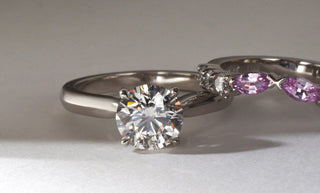
When people talk about diamonds, one of the first things they notice is how much they sparkle. But what actually creates that sparkle?
We hear many misconceptions about diamond sparkle; that a bigger diamond, a higher colour or clarity grade, or a more open setting will automatically mean more sparkle. In reality, the way a diamond is cut has one of the biggest influences on how it interacts with light.
What Actually Makes a Diamond Sparkle?
A diamond's sparkle comes from the way it interacts with light. When light enters a well-cut diamond, it travels through the stone and is reflected back towards the viewer. The angles and proportions of the facets determine how effectively this happens.
When you move a diamond, you see flashes of light and dark across the stone. Some of those flashes are bright white light, while others can appear as flashes of colour.
Cut Is One of the Most Important Factors
When we talk about diamond cut, we are not talking about the shape of the diamond. Shape refers to whether the diamond is round, oval, pear, cushion and so on. Cut refers to how well the diamond has been proportioned, faceted and finished.
The proportions, symmetry and angles of the facets all influence how light travels through the diamond. These elements need to work together to create the right balance. A diamond can have a symettrical crown and pavilion, for example, but if the angles between them don't work well together, the diamond will still lack life.
When these elements are well balanced, more of the light entering the diamond is returned towards the viewer, giving the stone its brightness and sparkle. Poorly balanced proportions can allow more light to escape instead, making the diamond appear darker or less lively.
The different types of diamond sparkle
There are a few different ways we describe the light you see coming from a diamond.
Brightness is the white light reflected back from the diamond.
Fire refers to flashes of spectral colour created when white light is dispersed as it passes through the diamond.
Scintillation is the pattern of flashes of light and dark you see as the diamond or the viewer moves.
Together, these characteristics contribute to the lively appearance that we commonly describe as sparkle. A beautiful diamond isn't necessarily producing one single type of light. It is the combination of brightness, fire and scintillation that gives the stone its character.
What Does an Excellent Cut Grade Mean?
One of the ways cut quality is assessed is through a laboratory grading report.
GIA, for example, grades the cut quality of round brilliant diamonds from Excellent through to Poor, taking factors such as proportions, symmetry and polish into account. Excellent is the highest GIA cut grade available for a round brilliant diamond.
However, two diamonds can both receive an Excellent cut grade and still look different.
This is because the Excellent category covers a fairly broad range of proportions, and the way those proportions interact with one another is important. For example, total depth is one of the measurements we look at. A round diamond with a total depth around 62% might have a table around 57%, while a shallower diamond might need a larger table to maintain a good balance between its proportions.
This is why we don't simply look for an Excellent grade and assume that all Excellent diamonds will perform in exactly the same way. The grade is an important starting point, but the individual proportions still matter.
What Are Hearts and Arrows Diamonds?
For round diamonds, we place particular emphasis on Hearts and Arrows diamonds.
Hearts and Arrows refers to a pattern created by an exceptionally precise arrangement of the diamond's facets. When viewed from the top, you can see a pattern of symmetrical arrows. When viewed from the bottom, you can see a series of hearts.
The pattern is created by extremely precise facet alignment and symmetry. It is a good visual indication of the level of precision that has gone into cutting the diamond.
Not every Excellent-cut round diamond will display a clear Hearts and Arrows pattern. Hearts and Arrows diamonds represent a particularly high level of precision in the cutting process.
You can read more about how Hearts and Arrows diamonds are created and what the pattern means in our guide to Hearts and Arrows Diamonds.
Does Diamond Colour Affect Sparkle?
Colour and sparkle are two different characteristics. Colour refers simply refers to the presence, or absence, of colour within the diamond.
For example, a D-colour diamond has a higher colour grade than an H-colour diamond, but that doesn't mean it will sparkle more.
A well-cut diamond will be incredibly bright and lively, regardless of its colour, while a poorly cut diamond would appear less impressive; even if it has a high colour grade. In fact, a well cut diamond can often trick the eye into appearing ‘whiter’ simply because of how it reflects light.
Colour is still an important consideration, particularly if you prefer a very white-looking diamond, but it shouldn't be confused with light performance.
Does Clarity Affect Sparkle?
Clarity describes the presence of inclusions and blemishes within or on the surface of a diamond. It doesn't directly measure how well the diamond interacts with light.
Significant inclusions can affect a diamond's appearance, particularly if they interfere with the passage of light. Salt and pepper diamonds, for example, can contain so many inclusions that they become partly or largely opaque and therefore don't have the same bright appearance as a clear diamond.
However, once a diamond is sufficiently clean to the naked eye, moving to higher and higher clarity grades doesn't make it look more sparkly. An SI1 diamond would look just as bright and lively as a VVS or flawless diamond, provided the cut and other characteristics are comparable.
Does a Bigger Diamond Sparkle More?
Carat is a measurement of weight, not physical size, and a larger diamond isn't automatically a more brilliant one.
A well-cut 0.8ct diamond can look brighter and more lively than a poorly proportioned 1ct diamond. The 1ct diamond weighs more, but some of that extra weight may be hidden in its depth rather than contributing to the diamond's face-up appearance.
This is another reason why looking at the actual measurements and proportions of a diamond is useful when comparing stones.
Does the Setting Affect How Much a Diamond Sparkles?
This is a question we are asked quite often, particularly when someone is considering a rubover setting.
There is a common belief that a diamond needs lots of light entering through the sides in order to sparkle. This isn't really how diamond light performance works.
A well-cut diamond is designed to receive light and return it towards the viewer through the top of the stone. Its light performance comes from the way its facets are proportioned and aligned, rather than having an open setting around the sides.
A rubover setting can cover the edge of the diamond, but it won't stop a well-cut diamond from sparkling. In fact, a rubover setting can also be an excellent choice for someone who wants a clean, contemporary appearance or a little more protection around the edge of the stone.
The quality and cut of the diamond remain far more important to its sparkle than whether it is held by claws or surrounded by a rubover setting.
What About Different Diamond Shapes?
Different diamond shapes have different facet arrangements, so they interact with light in different ways. Broadly, they can be divided into brilliant cuts and step cuts.
Round brilliant diamonds are the classic example of a brilliant cut, and they reflect the light through an array of triangular shaped facets. Oval, pear, cushion and radiant diamonds also use brilliant-style faceting, although their elongated or modified shapes can produce different patterns of light. In some elongated shapes, for example, you may see a darker area across the centre known as a bow-tie.
Emerald-cut diamonds are a classic example of a step cut, with larger, linear facets. Step cuts tend to produce broader flashes of light rather than the rapid scintillation associated with a round brilliant.
They can still be bright and beautiful, but the effect is more understated and often suits someone who prefers a cleaner, more architectural look.
What We Look for Beyond the Grading Report
A diamond grading report gives you important information about a stone, but it doesn't tell you everything about how that particular diamond looks and performs.
When we source diamonds, we look at detailed information alongside the grading report. This gives us a much more complete picture of the stone before we consider it for a client.
Diamond Videos
A good diamond video allows us to look at the stone from different angles and see how it interacts with light as it moves. We can assess its overall brightness and sparkle, look for areas that appear unusually dark, and get a feel for the diamond's general appearance.
ASET and Hearts and Arrows Analysis
For some diamonds, we will also receive ASET images or Hearts and Arrows analysis.
An ASET image provides information about how a diamond is handling light, including areas of light return and light leakage. This can be particularly useful when assessing fancy shapes such as ovals, where there is a much wider range of proportions and facet arrangements.
Hearts and Arrows analysis is used for round brilliant diamonds and helps us assess the precision and symmetry of the facet arrangement.
These are more technical tools, but they give us additional information about the diamond that isn't contained in a standard grading report.
Lustre and Crystal Structure
The internal structure of a diamond can also affect its appearance.
Some diamonds can have a slightly milky or hazy appearance, sometimes described as lower lustre. This can affect the way light travels through the stone and reduce its crisp, lively appearance, even when the diamond has otherwise good grades.
This isn't something that can always be understood simply by looking at the 4Cs. It requires looking at the actual diamond and assessing how clear and lively it appears.
Fluorescence
Some diamonds fluoresce when exposed to ultraviolet light. Blue is the most common fluorescence colour, although other colours can occur.
Fluorescence isn't automatically positive or negative, and weak to medium fluorescence will generally have no noticeable effect on a diamond's appearance. However, in a small number of diamonds, strong fluorescence can be associated with a hazy or milky appearance.
Looking at the Whole Diamond
This is why we don't choose diamonds based solely on finding the highest possible colour and clarity grades.
The grading report gives us important objective information about the diamond's characteristics, while videos, ASET images, Hearts and Arrows analysis and our assessment of the individual stone can tell us much more about how it actually looks and performs.
Ultimately, a diamond is something you look at rather than simply something you read about on a certificate. The combination of all this information helps us identify diamonds with the brightness, sparkle and overall appearance we're looking for.